

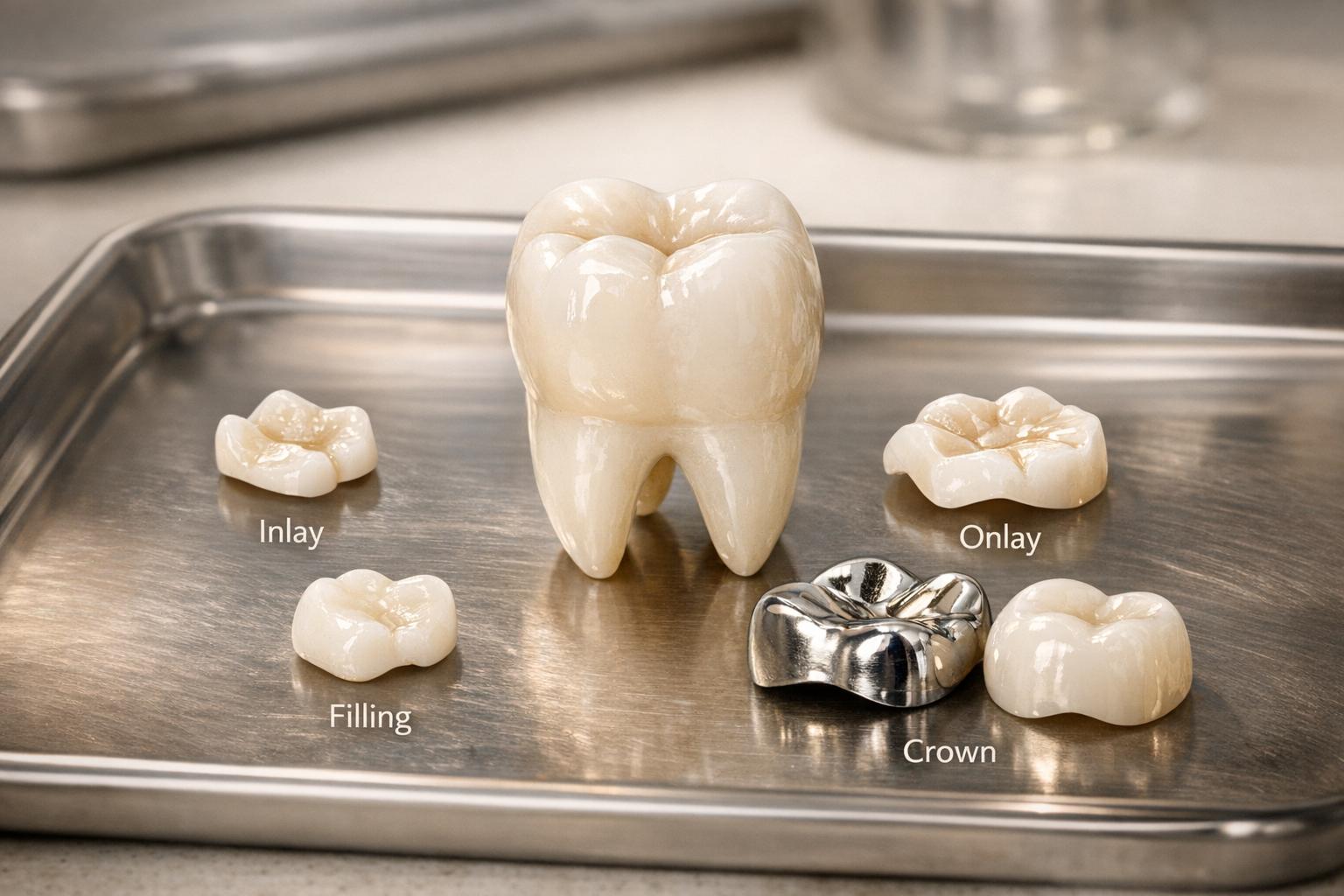
When your teeth suffer from decay, fractures, or wear, dentists use four main restoration options: fillings, inlays, onlays, and crowns. Each solution depends on the extent of damage and how much of the natural tooth can be preserved. Here’s a quick breakdown:
- Fillings: Ideal for small cavities or minor damage. Quick, cost-effective, and usually completed in one visit. Lifespan: 5–15 years.
- Inlays: Custom-made for moderate damage that doesn’t involve the cusps. Stronger than fillings and can last 10–30 years.
- Onlays: Cover one or more cusps, offering more protection than inlays. Often called "partial crowns", they last 10–30 years.
- Crowns: Fully encase the tooth, used for severe damage or post-root canal treatment. Lifespan: 15–20 years.
Quick Comparison:
| Restoration Type | Coverage | Lifespan | Best For | Cost (India) |
|---|---|---|---|---|
| Fillings | Small cavities | 5–15 years | Minor decay | ₹1,500–₹4,000 |
| Inlays | Between cusps | 10–30 years | Moderate damage | ₹5,000–₹10,000 |
| Onlays | One/more cusps | 10–30 years | Significant damage | ₹5,000–₹10,000 |
| Crowns | Entire tooth | 15–20 years | Severe damage | ₹3,490–₹9,490+ |
The right choice depends on the damage severity, tooth location, and material preferences. Regular dental care and hygiene are crucial to extend the lifespan of any restoration.
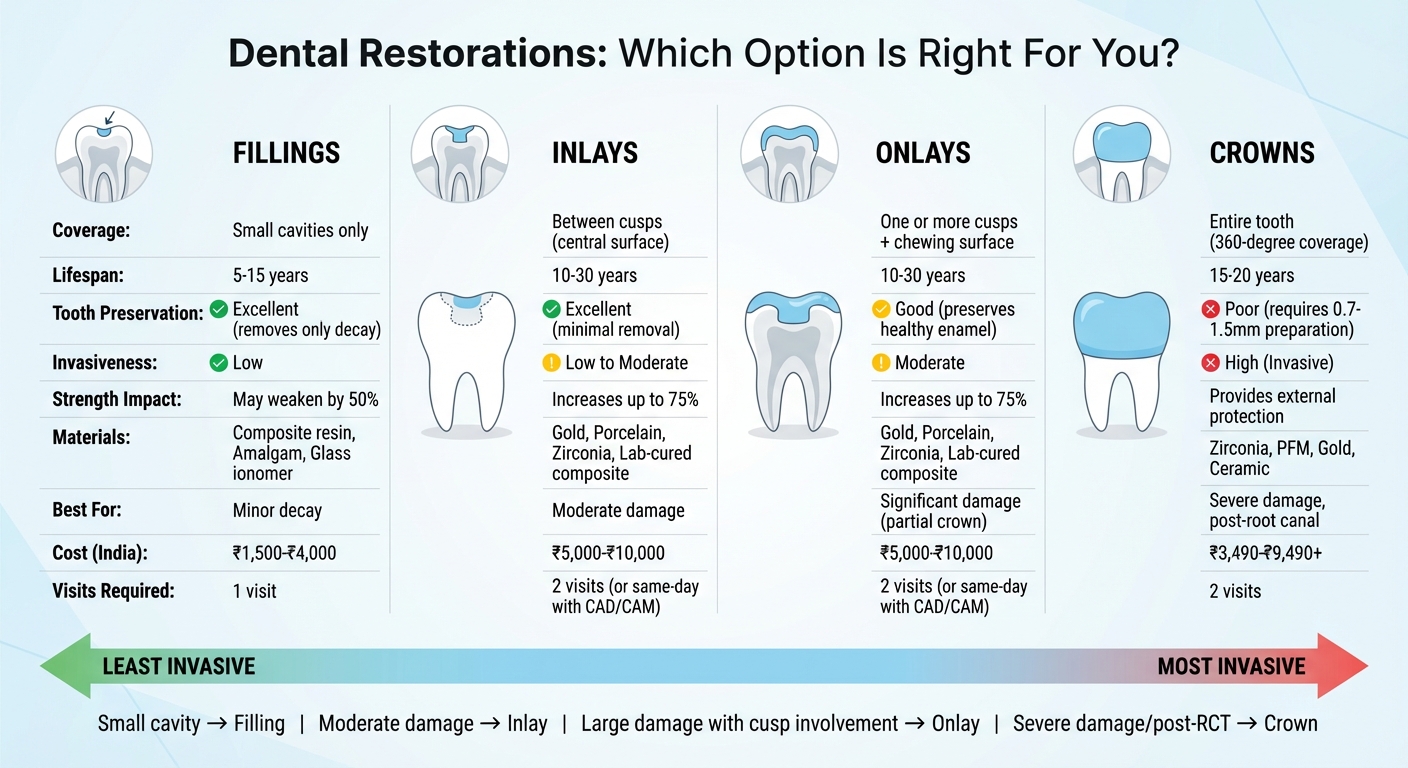
Dental Restoration Options Comparison: Fillings vs Inlays vs Onlays vs Crowns
Filling, Inlay, Onlay and Crown
What Are Fillings?
Fillings are used to fix small cavities, chips, or cracks in teeth. During the procedure, your dentist removes any decay, cleans the area, and fills the space with a durable material to restore the tooth’s structure and function. This process also seals off the tooth, preventing bacteria from entering and reducing the risk of further decay.
"Dental fillings strengthen your existing tooth structure and reduce your risk of further decay. That means less time in the dental chair and less money spent in the long run." – Cleveland Clinic
Typically, fillings are completed in a single visit, making them a quick and cost-efficient solution for repairing small to medium cavities.
Materials Used in Fillings
The material chosen for a filling depends on factors like the cavity’s location, its size, and your personal preferences. Here are some common options:
| Material | Appearance | Best For | Key Benefit |
|---|---|---|---|
| Amalgam | Silver/Metallic | Molars | Long-lasting and budget-friendly |
| Composite Resin | Tooth-coloured | Front teeth | Matches natural tooth colour |
| Glass Ionomer | Tooth-coloured | Children’s teeth/Below gumline | Releases fluoride to reduce further decay |
| Gold | Gold/Metallic | Molars | Extremely durable and long-lasting |
- Amalgam: This material is a mix of mercury, silver, tin, zinc, and copper. Known for its strength, it can last 10–15 years or more, making it ideal for molars that handle heavy chewing. However, its metallic colour makes it less appealing for visible teeth. The FDA advises pregnant women, children under six, and individuals with kidney issues to avoid mercury-based amalgam when possible.
- Composite Resin: Made from a blend of resin and powdered glass or quartz, this tooth-coloured material is perfect for visible teeth, as it blends seamlessly with your natural enamel. While not as durable as metal options, it’s a popular choice for maintaining a natural look, especially in the "smile zone".
- Glass Ionomer: Composed of silica glass powder, this material is often used for children’s teeth or areas below the gumline. It releases fluoride to help prevent further decay but is less durable and more prone to wear compared to other materials.
- Gold: Gold fillings are exceptionally strong and can last a lifetime. However, they come with a higher price tag and a metallic appearance that might not appeal to everyone.
When Are Fillings Recommended?
Fillings are ideal for repairing minor cavities or damage when enough healthy tooth structure remains to support the material. They are most effective for cases that can be treated in a single visit.
However, if the decay has reached the tooth’s pulp – the innermost layer containing nerves and blood vessels – a filling won’t be enough. In such situations, root canal therapy is usually required. Similarly, if the cavity is too large, a filling might weaken the tooth, making an inlay, onlay, or crown a better option to prevent fractures.
After getting a filling, it’s best to wait until the anaesthesia wears off before eating. This helps you avoid accidentally biting your cheek or tongue.
Up next, we’ll look at how advanced restorations like inlays can address more extensive decay that goes beyond the scope of standard fillings.
What Are Inlays?
Inlays are custom-made dental restorations designed to repair decay on the chewing surface of a tooth, specifically between the raised parts known as cusps. Unlike traditional fillings, which are applied directly into the cavity, inlays are crafted externally – either in a dental lab or using advanced CAD/CAM technology – and then permanently bonded to the tooth.
"An Inlay is similar to a filling and lies inside the cusp tips of the tooth… it is a filling which is constructed at the laboratory." – Andreas Aspros, Aspros Centre for Advanced Dentistry
This external fabrication process offers some key benefits. While conventional fillings can weaken a tooth by as much as 50%, inlays can strengthen it by 50% to 75%. They also avoid the shrinkage issues associated with composite fillings, reducing the risk of bacterial gaps.
Dentists often recommend inlays when a cavity is too large for a standard filling but the tooth is still structurally sound enough to avoid the need for a crown. They are particularly effective for addressing moderate damage in the pits and grooves of back teeth, which endure significant chewing pressure. Up next, let’s explore how these restorations are crafted with precision.
How Inlays Are Made
Creating an inlay typically involves two dental visits, although same-day placement is possible with CAD/CAM technology. During the first visit, the dentist removes the decay, shapes the cavity with rounded internal angles, and takes an impression of the tooth – either physically or digitally.
The impression is sent to a dental lab where technicians craft the inlay. Materials commonly used include:
- Porcelain or ceramic: Matches natural tooth colour and resists staining.
- Gold: Known for durability and resistance to fractures.
- Composite resin: A more affordable option.
- Zirconia: Valued for its exceptional strength.
If CAD/CAM technology is available, a 3D scanner captures the tooth’s precise dimensions, and a milling machine carves the inlay from a solid block of material directly in the clinic. This eliminates the need for temporary restorations and additional appointments. Once the inlay is ready, the dentist bonds it to the tooth using dental cement. To prevent fractures, inlays are typically crafted with a minimum thickness of 1.5–2mm. This detailed process ensures inlays are effective for repairing moderate decay.
When Are Inlays Used?
Inlays are often the go-to solution when the damage to a tooth is too extensive for a simple filling but doesn’t require the removal of healthy tooth structure for a crown. This makes them a middle-ground option in restorative dentistry.
They are especially useful when previous fillings have failed or fractured, signalling the need for a more durable restoration. Inlays also come in handy when achieving proper bite alignment is difficult with standard filling materials.
Durability is another advantage. While traditional fillings typically last 5–15 years, inlays can last anywhere from 10 to 30 years with good oral hygiene. One study even reported a 100% survival rate over 10 years for ceramic inlays bonded with chemically cured resin. In India, the cost of inlay treatments generally ranges from ₹5,000 to ₹10,000 per tooth.
Since inlays are placed in areas where teeth meet, maintaining them requires consistent flossing and interdental brushing to prevent decay along the edges. Their custom-fit design also makes them less prone to plaque buildup compared to some direct restorations, making long-term care easier.
What Are Onlays?
Onlays are a type of dental restoration designed to preserve as much of your natural tooth structure as possible while providing extra reinforcement. Unlike inlays, which fit snugly within the grooves of a tooth, onlays go a step further. They extend over the chewing surface and cover one or more cusps, offering added protection to weakened areas of the tooth.
"Onlays, which are sometimes called partial crowns, may be used if more than half of the biting surface of the tooth is decayed or otherwise in need of repair." – Andreas Aspros, Aspros Centre for Advanced Dentistry
These restorations are custom-made, either in dental labs or using CAD/CAM technology, and are permanently bonded to the tooth. Onlays are crafted from materials like porcelain, ceramic, gold, composite resin, or zirconia, and their primary purpose is to protect against fractures by covering the cusps. The extra coverage they provide makes them especially useful for teeth with significant damage.
Studies have shown that onlays have a success rate of about 90% over five years and 85% over ten years. With proper care and oral hygiene, they can last anywhere from 10 to 30 years, far outlasting standard fillings.
Onlays vs Inlays
The key difference between onlays and inlays lies in the area they cover. Inlays are designed to fit within the grooves of a tooth, making them ideal for smaller cavities or central damage. Onlays, on the other hand, extend to cover one or more cusps, making them better suited for more extensive damage, such as cracked cusps or larger cavities. Both options focus on preserving the natural tooth structure, but onlays provide broader protection for teeth with compromised cusps. This makes them a preferred choice when the damage requires more reinforcement than an inlay can offer.
When Are Onlays Used?
Onlays are often recommended for situations where the damage is too extensive for a filling or inlay but not severe enough to require a full crown. They are particularly effective in cases of fractured cusps or when decay has spread across a large portion of the biting surface.
They are also a common choice after procedures like root canal treatments. In such cases, onlays provide the necessary coverage to protect the remaining tooth structure while preserving more of the natural tooth compared to a crown. Dentists often prefer onlays for their ability to offer support and prevent future fractures when standard fillings wouldn’t suffice.
"An Inlay or Onlay is a much more conservative restoration for the tooth than a metal filling or even a crown." – Andreas Aspros, Aspros Centre for Advanced Dentistry
In India, the cost of onlay treatments ranges from ₹5,000 to ₹10,000. Porcelain onlays are typically more expensive than those made from composite resin. To ensure the longevity of an onlay, maintaining good oral hygiene is crucial. Regular flossing and interdental brushing can help prevent decay at the edges where the restoration meets the natural tooth.
What Are Crowns?
A dental crown is essentially a cap that covers the entire visible portion of a tooth above the gum line. Its purpose? To restore the tooth’s size, shape, strength, and appearance, especially when the tooth is severely damaged or weakened. Unlike fillings that simply fill a cavity or inlays that fit into specific grooves, a crown completely encases the tooth, offering robust protection and support.
When damage is too extensive for other restorations to handle, crowns step in as the ultimate solution. They form a protective barrier around the tooth, preventing further fractures and restoring its normal function. The process typically involves two visits: one to prepare the tooth and place a temporary crown, and another to fit the permanent crown.
"Zirconia is currently the top choice for crown material. It’s a cutting-edge metal that manages to provide you with a balance of strength and beauty." – Dr. Shreya Singh, Clove Dental
With proper care, crowns can last anywhere from 5 to 15 years. But remember, while the crown itself is artificial, the natural tooth beneath it remains vulnerable to decay, especially at the gum line. Regular brushing and flossing are non-negotiable to maintain oral health.
Types of Crowns
Crowns come in different materials, each catering to specific needs – be it strength, aesthetics, or a combination of both.
- Metal Crowns: Made from gold alloys or other metals, these crowns are highly durable and resistant to chips or fractures. They’re ideal for back molars where appearance isn’t a priority and are a great choice for patients with TMJ or bruxism due to their ability to withstand heavy biting forces.
- Porcelain-Fused-to-Metal (PFM) Crowns: These combine the strength of a metal core with a porcelain overlay, offering a balance of durability and aesthetics. They’re suitable for both front and back teeth, though the metal may become visible at the gum line over time.
- All-Ceramic/All-Porcelain Crowns: Known for their natural colour match, these crowns are perfect for front teeth. However, they’re less durable compared to metal or PFM crowns.
- Zirconia Crowns: These are prized for their strength and aesthetic appeal. They’re wear-resistant and biocompatible, making them a versatile choice for various dental restorations.
- Stainless Steel Crowns: Prefabricated and often used as a temporary solution for adults, these are also commonly used to protect children’s primary teeth until they naturally fall out.
| Material | Best Use Case | Durability | Starting Price (India) |
|---|---|---|---|
| Metal (Gold/Alloys) | Back molars, bruxism cases | Extremely durable | ₹3,490 |
| PFM | General use, bridge anchors | High; reinforced by metal | ₹4,690 |
| Zirconia | Versatile restorations | Very high; wear-resistant | ₹9,490 |
| All-Ceramic | Front teeth | Moderate; can be brittle | Varies |
Each material has its own strengths, helping dentists recommend the best option based on the tooth’s location and the patient’s needs.
When Are Crowns Necessary?
Crowns become the go-to solution when a tooth is too damaged for simpler restorations like fillings, inlays, or onlays. For instance, after a root canal treatment (RCT), a tooth often becomes brittle and prone to fractures. In such cases, a crown is essential to restore its strength and functionality.
"Adding a crown to the tooth after RCT is a must." – Clove Dental
Crowns are also integral to dental implants, acting as the prosthetic tooth placed on the implant post. They’re commonly used to anchor dental bridges, holding the prosthetic teeth securely in place. Additionally, when a tooth has a cavity too large for a standard filling, a crown provides the necessary reinforcement.
Beyond structural benefits, crowns also address cosmetic concerns. They can cover teeth that are severely discoloured, misshapen, or poorly formed, creating a natural-looking smile. For cracked teeth, crowns help hold the fragments together, preventing further damage.
To prolong the life of your crown, avoid using your teeth to open bottles or tear packaging. If you grind your teeth at night, wearing a mouthguard can help minimise wear and tear.
sbb-itb-25377e1
Coverage and Tooth Preservation Compared
When it comes to restoring damaged teeth, the goal is to retain as much of the natural tooth structure as possible. Different dental restorations – fillings, inlays, onlays, and crowns – vary in how much tooth material they require to be removed.
Fillings involve minimal preparation. Dentists only remove the decayed portion of the tooth before filling the cavity, which helps maintain the maximum amount of healthy tooth structure.
Inlays are designed to fit snugly between the cusps (the raised points on the chewing surface) without disturbing the healthy parts of the tooth. They replace only the damaged portion, ensuring that the surrounding structure remains intact.
Onlays, sometimes referred to as "partial crowns", extend further than inlays by covering one or more cusps. Despite this, they still conserve much of the healthy tooth by avoiding the extensive reshaping needed for a full crown.
Crowns, on the other hand, are the most invasive option. They require the tooth to be prepared on all sides – often reduced to a "stump" – to allow the crown to fit over it. Depending on the material used, this preparation involves reducing the tooth by 0.7–1.5 mm. While crowns offer strong protection, they come at the cost of removing a significant amount of healthy tooth structure.
"When dentists prep the tooth for a crown, they essentially destroy what remains of this shell, compromising the remaining structure." – Dr. Mark Flynn, The Modern Dentist
To better understand the differences, here’s a quick comparison:
| Feature | Fillings | Inlays | Onlays | Crowns |
|---|---|---|---|---|
| Coverage Area | Small, internal cavity | Between the cusps (central surface) | One or more cusps + chewing surface | Entire tooth (360-degree coverage) |
| Tooth Preservation | Excellent (removes only decay) | Excellent (minimal removal) | Good (preserves healthy enamel) | Poor (requires 0.7–1.5 mm preparation) |
| Invasiveness | Low | Low to Moderate | Moderate | High (Invasive) |
| Strength Impact | May weaken by 50% | Increases up to 75% | Increases up to 75% | Provides external protection |
Each option has its strengths and trade-offs, and the choice often depends on the extent of damage and the dentist’s recommendation.
Materials and Durability Compared
The choice of restoration materials plays a big role in determining how long they last and how well they perform. Fillings are considered "direct" restorations, meaning they’re placed and hardened directly in your mouth during a single dental visit. The materials used for fillings include composite resin (a mix of plastic and glass particles), silver amalgam (a metallic blend), and glass ionomer. While composite fillings can match the colour of your teeth, they are prone to polymerization shrinkage, which might lead to small gaps over time.
On the other hand, inlays, onlays, and crowns are "indirect" restorations. These are custom-made outside the mouth, either in a laboratory or using CAD/CAM technology, and then bonded to the tooth. This process allows the use of advanced materials like porcelain, lithium disilicate, zirconia, and gold alloys. Unlike composite fillings, these materials are fully polymerized before placement, which eliminates shrinkage issues. Porcelain and ceramic materials are known for their excellent wear resistance and natural look, but they need to be at least 2 mm thick to avoid brittleness. Zirconia is particularly strong and well-suited for back teeth that handle heavy chewing forces. Gold alloys, though less favoured due to their appearance, remain highly durable and require minimal tooth removal because of their flexibility. This external fabrication process not only ensures a better fit but also significantly boosts durability.
"While traditional fillings can reduce tooth strength up to 50%, inlays and Onlays made of high strength porcelain or composite systems (ADORO), can actually increase tooth strength by up to 75%, lasting 10 to 30 years." – Andreas Aspros, Aspros Centre for Advanced Dentistry
The lifespan of these restorations depends largely on the material used. Fillings generally last 5–15 years, inlays and onlays can last 10–30 years, and crowns typically last 15–20 years. Research shows that onlays have a success rate of 90% at five years and 85% at ten years. Ceramic inlays bonded with chemically cured resin have even shown a 100% survival rate after 10 years, compared to 77% for those bonded with dual-cured resin. Material choice also affects performance – metal fillings, for instance, are sensitive to temperature changes, while bonded ceramic restorations provide stable, long-lasting results.
| Restoration Type | Common Materials | Estimated Lifespan | Key Characteristics |
|---|---|---|---|
| Fillings | Composite resin, Silver amalgam, Glass ionomer | 5–15 years | Direct; economical; blends with tooth colour |
| Inlays | Gold, Porcelain, Zirconia, Lab-cured composite | 10–30 years | Indirect; fits between cusps; strengthens teeth |
| Onlays | Gold, Porcelain, Zirconia, Lab-cured composite | 10–30 years | Indirect; covers one or more cusps; often called a "partial crown" |
| Crowns | Zirconia, PFM (Porcelain-fused-to-metal), Gold, Ceramic | 15–20 years | Full coverage; most invasive; offers maximum protection for weak teeth |
Best Use Cases for Each Restoration
Here’s a breakdown of when each type of dental restoration works best, depending on the level of tooth damage and the need for preservation:
Fillings are a go-to solution for fixing minor decay and small cavities. They’re cost-effective and blend seamlessly with your natural teeth, making them a practical and aesthetic choice.
When decay goes beyond what a standard filling can handle but still leaves enough of the tooth intact, inlays step in. They’re a great option for situations where a large filling might weaken the tooth, as they can boost tooth strength by up to 50%.
For damage that affects larger areas, onlays provide extra protection by covering one or more cusps of the tooth. They offer a middle ground – preserving more of the natural tooth than a crown while still shielding it from moderate to significant decay. If you grind your teeth (bruxism), gold onlays are often recommended because they’re highly resistant to fractures.
When the damage is severe, and partial restorations just won’t cut it, crowns are the answer. They’re particularly crucial after root canal treatments or when a tooth is so weakened it’s at risk of breaking. Crowns completely encase the visible part of the tooth, providing all-around protection and restoring functionality.
"A dental crown is the best option for a more complete restoration after root canal therapy, as the tooth loses vitality and its nerves die." – Antlara Dental Clinic
Cost Comparison in India
When considering dental restoration options, understanding the costs is as important as knowing the benefits of each material. Here’s a quick breakdown of typical expenses in India:
- Composite fillings: ₹1,500–₹4,000
- Glass ionomer fillings: ₹1,500–₹3,500
- Inlays/Onlays: ₹5,000–₹10,000
Composite and glass ionomer fillings are completed in a single visit but generally last 5–10 years, meaning they may need replacement sooner. On the other hand, inlays and onlays, while more expensive upfront, can last up to 30 years, making them a better long-term investment. Since onlays cover a larger area, they are often slightly pricier than inlays.
The final cost for any restoration depends on several factors: the material used (composite, ceramic, or gold), the size and location of the cavity, the expertise of the dentist, and whether the treatment is being done in a metro or non-metro city. Among these, gold restorations stand out for their durability (lasting over 15 years) but come with the highest material costs.
Some advanced clinics, like The Dental Lounge, offer cutting-edge solutions through CAD/CAM technology. This allows for same-day restorations, eliminating the need for temporary fillings or multiple visits. By manufacturing restorations in-house, these clinics save time, ensure precision, and reduce indirect costs, making treatments more convenient for patients.
These cost insights highlight how modern dental restoration options can be tailored to meet different needs and budgets effectively.
Conclusion
Deciding between fillings, inlays, onlays, and crowns hinges on the extent of tooth damage and your long-term dental health priorities. Fillings are ideal for minor decay, lasting 5–15 years, and can typically be completed in a single visit. Inlays and onlays are better suited for moderate damage, offering durability of up to 30 years while preserving more of your natural tooth structure compared to crowns. Crowns, on the other hand, are the go-to solution for severely compromised teeth, especially after root canal treatment, providing full coverage with a lifespan of approximately 20 years.
The choice of restoration also depends on factors like the tooth’s location and the level of damage. Even a small cavity might benefit from an inlay or onlay for added strength and longevity. As previously mentioned, inlays and onlays are a more conservative option than crowns, which often require the removal of 1 mm to 1.5 mm of enamel. This approach helps retain as much of your natural tooth as possible, supporting long-term dental health.
For expert advice tailored to your unique needs, consider consulting The Dental Lounge, Bangalore. With advanced CAD/CAM technology enabling same-day restorations and a patient-first philosophy, they ensure you get the most suitable treatment – whether it’s a straightforward filling or a more robust inlay, onlay, or crown. Regular dental checkups remain essential to catch problems early and choose the most effective restoration for maintaining your oral health.
FAQs
How do I know if I need a filling, inlay, onlay, or crown?
When it comes to repairing a damaged tooth, the choice between a filling, inlay, onlay, or crown depends largely on how severe the damage is and where the tooth is located in your mouth.
- Fillings are ideal for small cavities or minor damage that’s limited to the enamel or dentine. They’re quick to apply, cost-effective (₹2,000–₹5,000), and help retain most of your natural tooth structure.
- Inlays are a step up from fillings, designed for damage that’s more extensive but still confined to the chewing surface between the cusps. They’re custom-made to ensure durability and a natural look.
- Onlays work well for more significant damage, especially when one or more cusps are involved. They’re a great choice for strengthening the bite surface, particularly for molars and premolars.
- Crowns are the go-to solution for teeth that are mostly damaged, weakened, or have undergone a root canal. They completely cover the tooth, offering superior protection and long-lasting durability.
Your dentist will weigh factors like the size of the damage, the tooth’s position, chewing pressure, and your budget to recommend the most suitable option for you. For expert advice and high-quality care, consider visiting a reliable clinic like The Dental Lounge in Bangalore.
What are the differences between inlays, onlays, and fillings in terms of durability and cost?
Inlays and onlays are specially designed dental restorations created in a lab, offering a sturdier alternative to traditional fillings. Inlays are used to fix damage confined to the chewing surface of a tooth, while onlays go a step further, covering one or more cusps to provide extra protection. Both are known for their durability and can last for several years with the right care.
When it comes to cost, inlays and onlays are priced higher than regular fillings, largely due to the premium materials and the lab work involved. In India, inlays generally cost between ₹8,000 and ₹15,000, whereas onlays fall in the range of ₹12,000 to ₹20,000, depending on whether porcelain or composite materials are used and the complexity of the restoration. Though they come at a higher price, their strength and longevity make them a smart choice for maintaining long-term dental health.
When should I choose a crown instead of other dental restorations?
When a tooth is severely damaged and smaller fixes like fillings, inlays, or onlays won’t do the job, a crown is usually the go-to solution. This is especially true if the tooth has had a root canal treatment, a large cavity, or a fracture that affects most or all of its cusps.
A crown fully covers the tooth, offering much-needed strength, protection, and long-lasting durability, making it the perfect choice for restoring teeth that are significantly weakened.

